DNA-doubled cells
clinical implications of cell biology
aggressive cancer resistance, cancer myths debunked, cancer research news, cell cycle checkpoints, cell division breakthrough, chromosomal instability, clinical implications of cell biology, DNA-doubled cells, myth about cancer cells, oncology drug targets, p53 cancer evasion, precision medicine future, tetraploid cancer cells, tumor biology explained, whole-genome duplication
Carolyn Stinnett
0 Comments
7 Shocking Cell Bio Breakthrough Facts About DNA-Doubled Cells
Cell Bio Breakthrough: Why DNA-Doubled Cells Refuse to Die
Cell Bio Breakthrough : Researchers this week reported a finding that uncovers the precise molecular trick a rogue cell uses to sidestep its own death warrant. That escape hatch explains how some of the most stubborn cancers get their start. And it gives drug developers a target they’ve been looking for.
How cell division works and where it goes wrong
Textbook cell division looks clean. Copy the DNA, split in two, done. It’s not like that in the body. In reality, cell division is a chaotic ballet of molecular checkpoints that constantly scan for errors — tripping an alarm if even one chromosome is out of place. A healthy cell has these little tripwires. If the DNA gets messed up, the cell is supposed to repair itself. If it can’t, it should enter a permanent growth arrest called senescence. And if that also fails, the last resort is apoptosis, a quiet self-destruct.
Sometimes, though, the whole process goes wrong in a specific way. The cell faithfully duplicates all 46 chromosomes to 92, but then fails to complete cytokinesis — the physical pinch that divides one cell into two. The result is a single cell with a double set of DNA. For decades, the prevailing view was that such tetraploid cells couldn’t survive. Too much genetic noise. The tumor suppressor p53 would spot the mess and shut them down. But if you look at a late-stage cancer biopsy under a microscope, you see the truth: nature finds a way around these checks all the time. Cell Bio Breakthrough
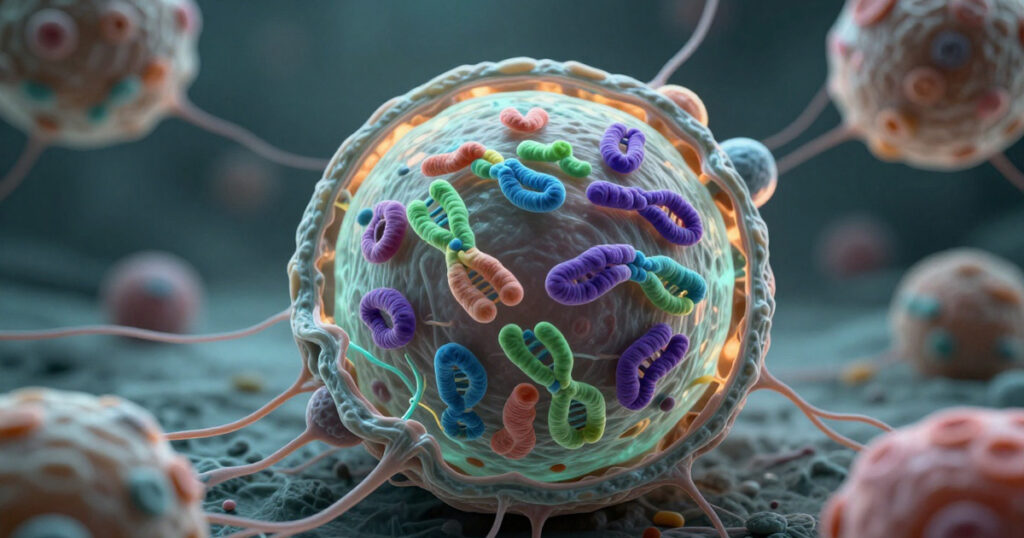
Cell Bio Breakthrough : The escape mechanism that keeps doubled cells alive
Cell Bio Breakthrough : The new study, published this month in a genetics journal, identifies the exact signal that lets these DNA-doubled cells slip through the body’s fingers. After copying its chromosomes but failing to split, the cell doesn’t lurch forward blindly. It latches onto a particular stress-response protein complex that normally helps a cell cope with structural wear. By co-opting that network, the cell muffles the last-ditch signals that would normally push it into apoptosis or permanent growth arrest.
Once that brake is loosened, the cell keeps dividing. Its progeny become genetically unstable, shedding and gaining chromosomes at random. This aneuploidy, having an abnormal number of chromosomes, is the hallmark of many aggressive, treatment-resistant cancers. Cell Bio Breakthrough The lead investigators, per Science Daily’s coverage, point out that the mechanism isn’t a rare fluke. It’s a reproducible weak spot.
Cell Bio Breakthrough: Why DNA-Doubled Cells Refuse to Die
Cancer research is full of surprises, but this latest Cell Bio Breakthrough may become one of the most important discoveries in years. Scientists recently uncovered how certain abnormal cells avoid self-destruction even after serious genetic mistakes occur. That single discovery could help explain why some aggressive cancers become nearly impossible to treat.
For decades, researchers believed cells carrying double the normal amount of DNA were too unstable to survive. Yet doctors repeatedly found these abnormal cells inside advanced tumors. The question remained unanswered: how were these damaged cells escaping the body’s built-in safety systems?
Now, scientists may finally have the answer.
This new Cell Bio Breakthrough reveals a precise molecular survival mechanism that allows rogue cells to ignore death signals and continue multiplying. Understanding this process could eventually lead to targeted therapies that stop dangerous cancers before they spread.
Scientists discover why some DNA-doubled cells refuse to die
What Is the Latest Cell Bio Breakthrough?
The recent Cell Bio Breakthrough focuses on tetraploid cells — cells that accidentally duplicate their entire DNA content but fail to split into two separate cells.
Cell Bio Breakthrough Normally, a healthy human cell contains 46 chromosomes. During cell division, the DNA temporarily doubles to 92 chromosomes before the cell divides cleanly into two daughter cells.
But sometimes, the final split never happens.
Instead of becoming two healthy cells, one oversized cell remains with twice the normal DNA. Scientists call this condition whole-genome duplication or tetraploidy.
For years, researchers assumed these cells would quickly die because of overwhelming genetic stress. However, advanced cancers proved otherwise. These cells not only survive but often become the foundation of aggressive tumors.
That contradiction pushed researchers to look deeper.
Why this matters for aggressive cancers
Cancers that pass through this tetraploid intermediate are bad news. They metastasize more readily and adapt to therapies faster. That tends to erode a patient’s prognosis. Until now, clinicians had no clear molecular explanation for how these cells became so aggressive. This discovery changes that. It gives drug developers a concrete target — a single protein handshake they can try to break. Basic research like this isn’t a sideshow. It’s the bedrock. Without it, we’d still be guessing why certain cancers refuse to respond to treatment.
The myth of the infallible immune system
A common belief is that the body’s immune system wipes out any dangerous cell before it can become a tumor. It’s a comforting thought. And it’s partly true: natural killer cells and cytotoxic T cells do perform tumor surveillance. But cancer is a collection of exceptions, and this mechanism is a perfect example of how the body fails. A DNA-doubled cell doesn’t overwhelm the immune system with brute force. It hides. It uses a stress-response trick that looks, to immune cells, like a normal repair operation. The cell blends in.
Cell Bio Breakthrough : What to ask your oncologist
If you’re a patient or a caregiver, you might not bring up tetraploidy in a clinic visit. The terminology is dense. But you can ask a smarter question: “Based on my tumor’s genomic profile, is there evidence of chromosomal instability or whole-genome duplication? And are there trials looking at drugs that target those survival pathways?” That question alone signals you’re paying attention. It pushes the conversation toward mechanism-based therapy rather than a one-size-fits-all regimen. The direct clinical applications are years off. But the more patients who demand science-driven reasoning, the faster the system moves.
And the larger question hangs in the air: how many more of these sly survival tricks are buried in the biology of cancer? We’re only now starting to ask the right questions.












Post Comment