FDA Ban on Compounded Semaglutide
GLP-1 Drugs
Compounded Semaglutide, Compounding Pharmacies, FDA Ban on Compounded Semaglutide, FDA Drug Regulations, GLP-1 drugs news, Ozempic Alternatives, Semaglutide Safety, Tirzepatide Regulations, Wegovy Shortage, Weight Loss Medications
Carolyn Stinnett
0 Comments
FDA Ban on Compounded Semaglutide: 7 Critical Facts Patients Must Know
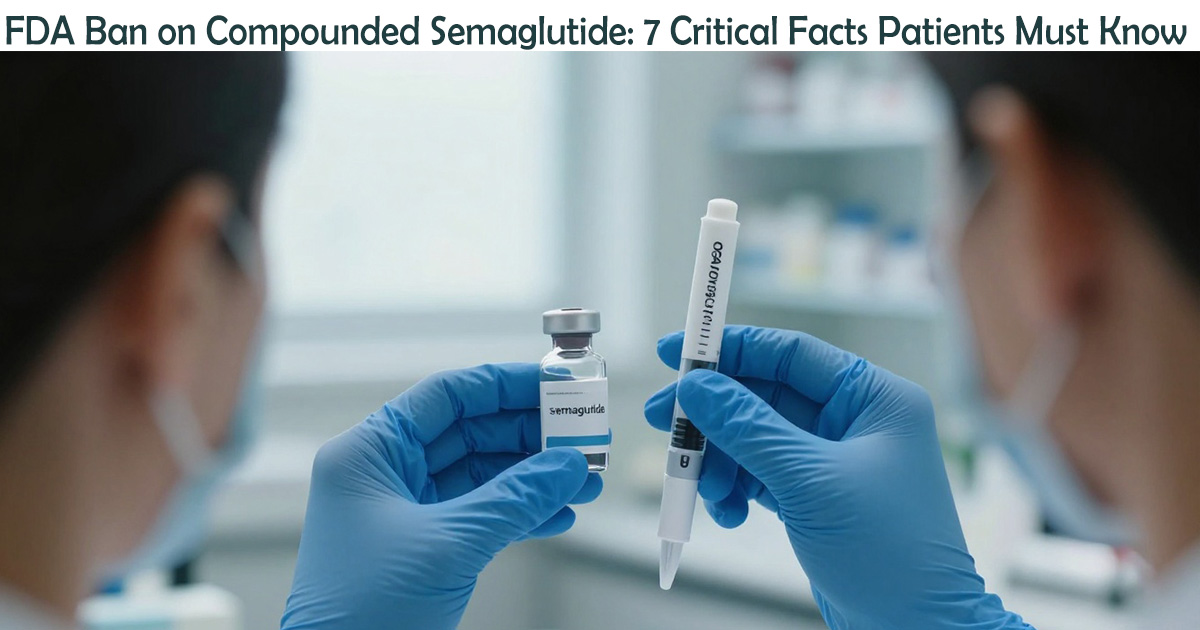
Drug Regulations: FDA Proposes Ban on Bulk Semaglutide/Tirzepatide Compounding
FDA Ban on Compounded Semaglutide – If you’ve been getting your Ozempic, Wegovy, or Mounjaro through a compounding pharmacy, a quiet regulatory shift might upend your access — and your budget. On April 30, 2026, the FDA announced it is considering removing the active ingredients in these blockbuster GLP-1 weight-loss drugs from a list that lets large compounding facilities churn out bulk supplies. In plain terms: the cheap, off-brand versions many patients relied on during the shortage may soon disappear. – FDA Ban on Compounded Semaglutide
Patients have started panicking. They’re the ones who finally found an affordable option after being denied brand-name coverage, or whose BMI no longer qualifies, or who simply cannot stomach the $1,000-a-month cash price. Losing that cheap supply feels like a sentence to regain all the weight. I hear versions of that fear at least twice a week now.
FDA clarifies policies for compounders as national GLP-1 supply begins to stabilize
What Are Compounded GLP-1 Drugs, and Why Are They Everywhere?
To understand the panic, you need to know how we got here. Semaglutide (the molecule in Ozempic and Wegovy) and tirzepatide (the powerhouse behind Mounjaro and Zepbound) have been in persistent shortage for over two years. Demand exploded. The brand-name manufacturers — Novo Nordisk and Eli Lilly — couldn’t keep up. Enter compounding pharmacies.
Under the FDA’s 503B rules, certain outsourcing facilities can buy raw semaglutide or tirzepatide powder in bulk from approved suppliers, mix it into sterile injectables, and sell it directly to clinics, med-spas, and patients. These are not one-off prescriptions like your corner pharmacist mixing a special ointment. These are assembly-line operations pumping out thousands of vials a month. Because compounders don’t carry the R&D or marketing costs of the big pharma companies, the price can be 70–80% lower. For a patient paying out of pocket, that’s the difference between accessing treatment and walking away empty-handed. FDA Ban on Compounded Semaglutide
But here’s the catch: the 503B bulks list is supposed to reflect a clinical need. When a drug is on the list, it means there’s a genuine public-health gap the approved drugs are not filling — often a shortage. When supply stabilizes, the rationale for bulk compounding evaporates.

FDA’s Concerns with Unapproved GLP-1 Drugs Used for Weight Loss
FDA Ban on Compounded Semaglutide : The FDA Move: What Is Happening
On April 30, 2026, the FDA issued a formal notice proposing to remove semaglutide, tirzepatide, and liraglutide (another GLP-1, older and less famous) from that bulks list. The agency is accepting public comments through the end of June 2026. A final decision will come after that.
This does not mean a total ban on all compounded GLP-1s. Small-scale compounding under 503A pharmacies — where a pharmacist makes a single patient’s prescription based on a specific, documented medical need — can still happen. But 503A doses are meant for individual exceptions, like a patient who is allergic to a filler in the brand-name pen. They were never designed to supply thousands of people per day. In practice, this means if the rule goes through, the cheap, widely available compounded semaglutide and tirzepatide that fueled the telehealth boom will dry up almost immediately.
Behind the FDA’s reasoning is a simple fact: the declared shortage of brand-name GLP-1 drugs has largely ended. Novo Nordisk and Lilly have ramped up manufacturing. When there is no longer a shortage, continuing to allow bulk compounding undercuts the approved drug manufacturing and oversight system.
FDA Ban on Compounded Semaglutide – The Safety of Compounded Versions
FDA Ban on Compounded Semaglutide – This is where it gets uncomfortable. Many of my patients assume that because a compounded shot comes in a vial that looks professional, it’s just as safe as the branded pen. That is not true, and the FDA’s proposed action is partly a safety measure.
FDA-approved medications go through years of clinical trials and ongoing purity testing, plus strict manufacturing audits. Compounded drugs, even from legitimate 503B facilities, do not go through FDA pre-market approval. The facilities themselves must follow good manufacturing practices, but the finished product is never named an FDA-approved drug. Buying a compounded version is like buying a generic electronic charger from a reputable third-party brand versus the original manufacturer’s charger. It might work perfectly, or it might overheat.
The concerns are not theoretical. The FDA has warned repeatedly about compounded semaglutide being made with salt forms of the molecule (like semaglutide sodium or semaglutide acetate) that have never been tested for safety or efficacy in humans. Those are not the same as the active ingredient in Ozempic. There have been reports of contamination and inaccurate dosing, plus severe side effects. Some analyses suggest that compounded GLP-1 drugs are associated with a higher rate of adverse events than the brand-name versions. Clinically, I have seen patients who developed violent nausea and vomiting at doses that should have been tolerable — likely because the concentration in the vial was not what the label claimed.
Now, I am not saying all compounded versions are dangerous. Many high-quality compounding pharmacies do rigorous in-house testing. But the risk is uneven. When a patient gets a vial from an online clinic where the price seems too good to be true, I brace myself.
The Myth That Cheaper Means the Same Medicine
This is the misconception that keeps me up. A startling number of people genuinely believe that compounded semaglutide is identical to Wegovy, just without the fancy pen. The logic goes: “It’s the same molecule, so it must be the same.” Clinically, that’s a dangerous oversimplification.
First, as I said, the salt form may differ. Second, sterility and potency can vary from batch to batch. Even if you get actual semaglutide base, the dose you draw up might be off by 10 or 20%. In a drug where the difference between 1 mg and 2.4 mg is the line between mild appetite suppression and debilitating side effects, that slosh matters.
None of this means you were foolish to use compounded medication. In a broken system where insurance won’t pay and brand-name prices hover around $1,000 a month, people make the best choice they can with the information they have. But the myth that these are identical products can hurt you. – FDA Ban on Compounded Semaglutide

What to Do Now: A Practical Game Plan
If this news has you sweating, here’s a clear-eyed approach. You have time — the FDA rule is not final yet, and even after it goes into effect, existing supply will take weeks to fully wind down. Here’s what I’m telling my patients:
1. Call your insurance company — even if you have been denied before. Formularies are changing. Some plans that refused to cover Wegovy or Zepbound for weight loss in January are now adding them with prior authorization. It is a 15-minute phone call that might save you hundreds a month. Don’t assume the answer is still no.
2. Look into manufacturer savings programs. Novo Nordisk and Eli Lilly both offer copay cards and patient assistance programs for people with commercial insurance or those whose insurance will not cover the drug. I have seen patients with high-deductible plans get their brand-name GLP-1 for as little as $25 a month through these. GoodRx and similar services can also knock a chunk off the cash price if you are paying out of pocket.
3. Have an honest conversation with your doctor about alternatives. There are older generic weight-loss medications — phentermine, naltrexone/bupropion, or orlistat — that do not work as powerfully as GLP-1s but can help some people maintain weight while you sort out coverage. Structured medical weight-loss programs with a dietitian and behavioral support are also evidence-based. I know it is not the same, but it is better than going it alone or, worse, buying overseas “semaglutide” from a website that ships in unlabeled vials. Those products can be outright counterfeit. The risk of contamination or missing active ingredient is not theoretical.
4. If you must stay on a compounded version for now, ask hard questions. If your provider uses a compounding pharmacy, call them. Ask: “Do you use semaglutide base, or a salt form? Do you have a certificate of analysis from an independent lab for this batch? How do you ensure sterility?” A decent compounding pharmacist will answer those without hesitation. If they get cagey, walk away. – FDA Ban on Compounded Semaglutide
5. Don’t panic-buy a six-month stockpile. These are injectable peptides with a limited shelf life once reconstituted. Storing them improperly can degrade the drug. And hoarding only drives more shortage and panic.
I am not naive. I know that many of my patients will feel cornered. The U.S. healthcare system fails people with obesity every day by treating their condition as a cosmetic nuisance rather than a chronic disease. The FDA’s move, sensible as it is from a safety standpoint, will hurt people who have finally found an affordable treatment that works. That tension — safety versus access — is the uncomfortable truth at the center of this policy.
We are in a transition window. Use it to explore legitimate insurance pathways and patient-assistance options. Do not let fear push you toward an unregulated source that could do real harm. If you are already on a compounded version and the supply evaporates, do not just stop cold — come back to your clinic. We can map out a transition.
But what happens to the thousands of people who found an affordable treatment and now face losing it? That is the question the FDA’s decision leaves open.

FDA Ban on Compounded Semaglutide : Final Thoughts
The FDA Ban on Compounded Semaglutide could reshape the future of affordable weight-loss treatment in the United States.
For some patients, the proposal feels devastating. Others see it as a necessary safety measure.
The reality is complicated.
Compounded GLP-1 medications helped many people gain control of their health during a period of severe drug shortages. But concerns about quality, dosing, and regulation are real and cannot be ignored.
If you currently rely on compounded semaglutide or tirzepatide, now is the time to prepare. Speak with your healthcare provider, review insurance options, explore legitimate savings programs, and avoid risky unregulated sources.
Most importantly, do not make decisions out of panic. A thoughtful transition plan can protect both your health and your progress. Final Thoughts
The FDA Ban on Compounded Semaglutide could reshape the future of affordable weight-loss treatment in the United States.
For some patients, the proposal feels devastating. Others see it as a necessary safety measure.
The reality is complicated.
Compounded GLP-1 medications helped many people gain control of their health during a period of severe drug shortages. But concerns about quality, dosing, and regulation are real and cannot be ignored.
If you currently rely on compounded semaglutide or tirzepatide, now is the time to prepare. Speak with your healthcare provider, review insurance options, explore legitimate savings programs, and avoid risky unregulated sources.
Most importantly, do not make decisions out of panic. A thoughtful transition plan can protect both your health and your progress. – FDA Ban on Compounded Semaglutide
This article is for informational purposes only and does not constitute medical advice. Always consult a licensed healthcare provider before starting, stopping, or changing any medication.











Post Comment