9 Powerful Oncology & Immunotherapy Breakthroughs Transforming Cancer Care
Oncology & Immunotherapy Breakthroughs
Two Advances, One a Low-Tech Fasting Trick, Excite Canadian Cancer Researchers
Oncology & Immunotherapy Breakthroughs : A short, strictly timed fast around chemotherapy extended progression-free survival by nearly six months in women with advanced ovarian cancer.
It’s a cheap, simple intervention that oncologists are starting to take seriously. At around the same time, a McGill University team showed they could temporarily knock out two checkpoint proteins that tumours use to hide from natural killer cells.
That work hasn’t left the lab yet. The fasting data will be presented at the American Society of Clinical Oncology meeting in Chicago later this month, and it’s already prompting calls for a dedicated Canadian trial.
Oncology & Immunotherapy Breakthroughs: The Ovarian Cancer Trial
The randomized study included women at several Canadian centres and has become one of the most talked-about examples of recent Oncology & Immunotherapy Breakthroughs.
Women who followed a fasting protocol—roughly 48 to 72 hours around each chemotherapy infusion—experienced progression-free survival improvements of nearly six months compared with women who ate normally.
Researchers believe these Oncology & Immunotherapy Breakthroughs could open a new direction in cancer treatment by improving how patients respond to chemotherapy without relying solely on expensive medications.
Dr. Helen MacKay, a medical oncologist at Sunnybrook Health Sciences Centre in Toronto, reviewed the findings and described them as “an elegant, low-tech way to widen the therapeutic window,” a statement that highlights why these Oncology & Immunotherapy Breakthroughs are attracting international attention.
The biology behind these Oncology & Immunotherapy Breakthroughs is surprisingly straightforward. A short-term fast causes insulin levels to drop sharply, helping healthy cells shift into a protective maintenance state.
Cancer cells, however, depend heavily on glucose and do not receive the same protection. That leaves tumour cells more vulnerable to chemotherapy while healthy tissue may better tolerate treatment.
What makes these Oncology & Immunotherapy Breakthroughs especially remarkable is that no pharmaceutical company can patent fasting itself, which means the research may advance more quickly through academic cancer networks rather than becoming delayed in commercial drug development pipelines.

Canadian oncologists strongly emphasize that nobody should attempt fasting during active cancer treatment without proper medical supervision.
Even so, several healthcare centres have already begun discussing nutritional strategies because of the promise shown by these Oncology & Immunotherapy Breakthroughs.
The Canadian Cancer Trials Group is now expected to launch a larger multi-centre study examining whether these Oncology & Immunotherapy Breakthroughs could also improve outcomes for colorectal and pancreatic cancer patients.
Advances in cancer immunotherapy and future directions in personalized medicine
A new checkpoint target on natural killer cells
At McGill’s Goodman Cancer Institute, researchers have been working on natural killer (NK) cells, the immune system’s first responders.
These cells can destroy abnormal tissue, but tumours often deploy molecular signals that tell NK cells to stand down. The team identified two such checkpoint proteins and developed an approach to block them transiently.
In preclinical models, that lifted the brakes and let NK cells punch through the tumour’s protective shell. The group will detail the work in a poster session at ASCO.
Immunologists outside McGill called it a promising twist on checkpoint inhibition. Existing checkpoint drugs largely act on T cells; shifting the concept to NK cells might open a complementary line of attack, especially for tumours that have become resistant to current therapies. Still, these are early-stage results. The next step is to engineer a drug-like molecule—likely a monoclonal antibody—that can safely and temporarily block those two proteins in humans. The team is talking to biopharmaceutical companies and academic drug-discovery centres. Whether that molecule gets made depends on someone betting on an unproven target.
Other immunotherapy moves
The global immunotherapy scene is noisy. A review in the *American Journal of Clinical Oncology* counted 260 active trials for T-cell receptor-engineered T cells (TCR-T), a more targeted cousin of CAR-T that tries to crack solid tumours like lung and liver cancers. Canadian investigators contribute to a few of those studies through sites in Toronto and Vancouver, but most remain in early phases.
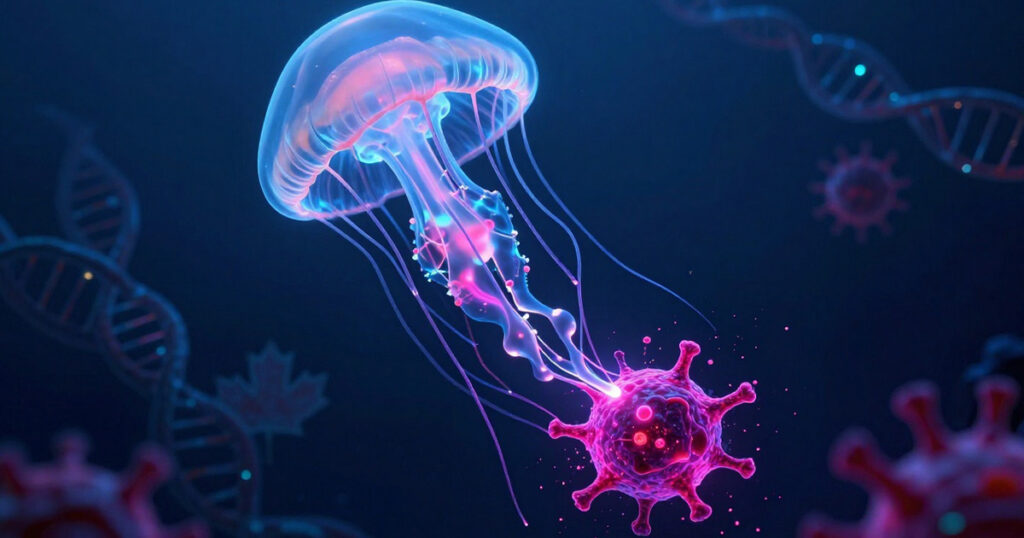
There’s also stranger stuff. An Israeli startup, Marine BioVenom, packages jellyfish venom in a lipid-based delivery system and reports dose-dependent destruction of cancer cells in lab tests while sparing healthy tissue—liver, breast, lung lines. The company wants to move toward first-in-human trials, though that will take years. In Australia, the ACRF Spatial Immune Oncology Research Program for childhood cancer launched this month, aiming to map tumour microenvironments in kids to guide immunotherapy choices. It’s integrated with the Zero Childhood Cancer precision-medicine platform, which has partnerships with Canadian paediatric networks. All of this is a reminder that immune-based cancer therapy is now an enormous, multi-billion-dollar industry where speed matters, but most ideas will fail.
‘It’s incredible, like science fiction’: How a new wave of immunotherapy is eliminating cancers
What’s next for Canadian patients
The McGill NK-cell work is still preclinical. If a drug candidate emerges, it would need to clear Health Canada hurdles and then face the slow grind of Phase I safety testing. The ovarian cancer fasting data, by contrast, could move faster. Canadian investigators from the international trial are pushing for a large, multi-centre Canadian arm that would also test whether the approach helps in colorectal and pancreatic tumours. The ASCO presentation will give oncologists their first proper look at the survival curves. For now, the question is whether a diet-based add-on can stand up to the scrutiny that any expensive new drug would get—and whether funders will care enough to find out.











Post Comment